Whose knowledge is missing when students learn with AI?
A University of Canterbury announcement today puts local knowledge, culture and assessment at the centre of AI literacy. The work is ongoing: no learning gains or completed interview findings are reported.
The short version
- What happened
- The university published its account of ongoing AI-literacy research on 21 October 2026.
- Who it affects
- Teachers can use the question to discuss source checking and local context; any classroom activity still needs permission, accessibility and privacy safeguards.
- What remains unproven
- This is a university announcement about ongoing research, not an independent evaluation or completed outcome paper.
Keep in mind
This is a university announcement about ongoing research, not an independent evaluation or completed outcome paper.
No interview sample, completed analysis, comparison group or measured learning effect is published in the announcement.
The classroom exercise in this article is our editorial suggestion and has not been validated by the reported project.
Source analysis · 1 linked source. Primary analysed source date: 21 October 2026.
Read the full report · 5 min The evidence, methods, implications and limitations
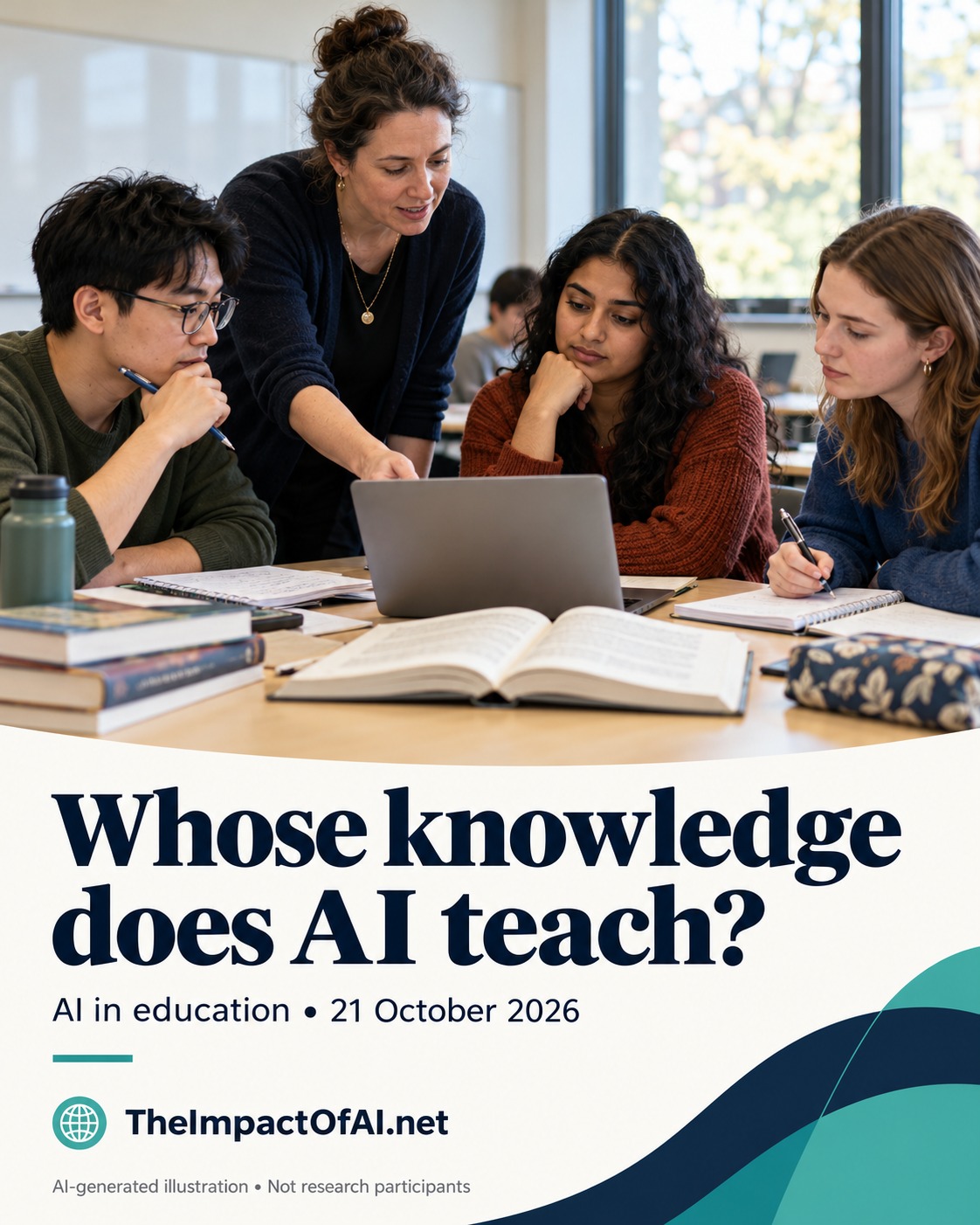
The classroom question beyond getting an answer
A student can receive a fluent answer and still need to ask whose knowledge shaped it. In an announcement published on 21 October, the University of Canterbury describes ongoing research into generative AI, local knowledge and assessment in New Zealand higher education. The team is examining cultural representation, including te reo Māori and mātauranga Māori, and is interviewing academics across disciplines. This is an account of work in progress, not a completed test of whether AI improves learning.[1]
AI literacy includes asking where knowledge comes from
The university says its project builds on the Scaffolded AI Literacy framework, with Māori and Pacific perspectives informing its design. The researchers are considering how AI literacy relates to teaching and assessment. The announcement follows a university symposium held on 20 October; the public announcement is dated today. It provides no interview sample, completed analysis or numerical estimate of cultural or educational effects.[1]
The distinction that matters
Three checks before accepting an AI explanation
An editorial checking exercise, not a validated intervention or a summary of measured study outcomes.
Source
Open the original references and identify who produced them.
Record what can and cannot be verified.
Context
Compare the answer with appropriate local knowledge and sources.
Identify assumptions, omissions and differing perspectives.
Reasoning
Explain how checking changed the conclusion.
Make the student's own judgement visible.
A practical exercise: compare the answer with its sources
The following is our editorial classroom suggestion, not an intervention evaluated by the Canterbury team. Choose a non-sensitive question about a place or topic students know well. Ask an authorised AI tool for an explanation, then compare it with appropriate original sources and locally produced material. Ask students to identify the author, date, purpose and perspective of each source. A confident answer should start a checking process rather than end it.
Look for what the answer leaves unspecified. Does it treat a country, community or tradition as if everyone shares one view? Does it distinguish a general account from a particular place, speaker or time? Can its references actually be opened? Record uncertainty instead of filling gaps with a plausible invention. Keep culturally restricted or confidential material out of a public AI service, and follow the institution's policies before using any tool.[1]
Assess the reasoning, not just the polished response
A second editorial suggestion is to ask students for a short explanation of what they changed after checking. They could show an initial answer, a source that challenged it and a revised conclusion. The useful discussion is about why the revision was justified. This exercise should be adapted to age, language, access needs and the learning objective; it is not presented here as a proven route to higher attainment.
Teachers can also state what AI is permitted to do in that task. Brainstorming, translation, feedback and producing a final submission create different assessment questions. Give students a way to disclose assistance and ask for clarification. A policy is easier to discuss when it names the learning that must remain visible, rather than relying on an unspecified instruction to use AI responsibly.[1]
What would turn this announcement into stronger evidence?
For this project, the next useful publication would explain who participated, how interviews were analysed, whose perspectives were included and what competing interpretations were considered. Any claim about learning gains would need its own outcome measures and an appropriate comparison. Teacher or student accounts can illuminate experience; by themselves they do not establish a causal effect. We will follow the evidence rather than treating today's announcement as a verdict on all classroom AI.[1]
Continue with the related education evidence
Our education desk also examines why an AI-writing detector should not decide a cheating allegation and how universities are redesigning assessment for generative AI. Those are separate reports with their own source dates, methods and limitations. Use the related links below to compare the questions they answer; neither independently validates the Canterbury project. For discussion: what local knowledge or perspective would you want students to check before accepting an AI-generated explanation?[1]